
The £5bn Opportunity: Why Accountants are the Key to SME Sustainability in the UK

The SME Sustainability Surge and the Opportunity for UK Accountants
In the UK accountancy world, we often talk about "future-proofing." Usually, that means digitisation or moving to the cloud. But as we look to 2026 and beyond, the definition of future-proofing has shifted.
The "scene" for 2025 was one of resilient but constrained growth. UK SMEs are navigating a complex landscape of cost inflation and a staggering £65–90bn lending gap (1)(2). Yet, amidst these structural pressures, a new commercial lever has emerged: Sustainability.
At Soar, we are already seeing a fundamental shift in the market and have invested accordingly to meet the growing demand. Sustainability is no longer a “nice-to-have” CSR initiative, it is fast becoming a commercially material requirement.
Crucially, the role of the accountant is evolving alongside this shift. Sustainability is increasingly being recognised not just as an ethical consideration, but as a core component of operational resilience and business continuity. It requires a holistic, top-down view of an organisation; identifying and assessing the full spectrum of risks that could impact performance, viability, and long-term value.
In this context, sustainability becomes integral to one of accountancy’s most fundamental responsibilities: determining whether a business can confidently be treated as a going concern.
1. The 2025 Landscape: From "Optional" to "Material"
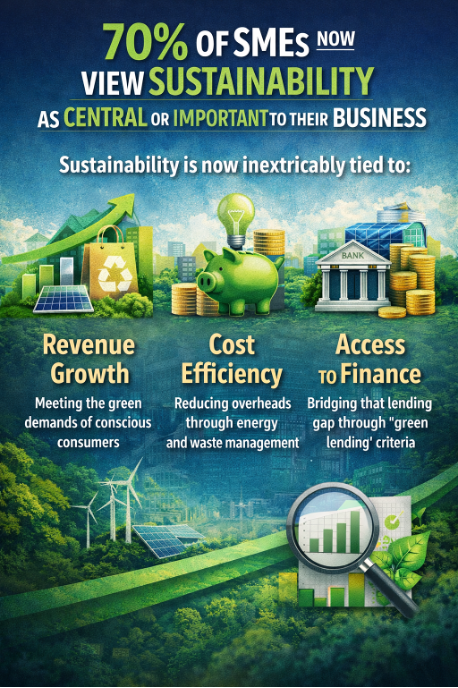
According to recent data, 70% of SMEs (3)(4) now view sustainability as central or important to their business. This isn’t just about altruism; it’s about survival and growth.
Sustainability is now inextricably tied to:
Revenue Growth: Meeting the green demands of conscious consumers.
Cost Efficiency: Reducing overheads through energy and waste management.
Access to Finance: Bridging that lending gap through "green lending" criteria.
For the modern SME, ESG is no longer a compliance box to tick; it is a growth lever.
2. 2026: The Year of Obligation
As we transition in the second quarter of 2026, we are witnessing a structural shift. The UK’s sustainability reporting requirements are no longer staying at the "top" of the market. They are cascading through supply chains.
Large corporations are now pushing ESG requirements down to their SME suppliers. If an SME wants to keep its contracts with major players, it must provide measurable, auditable ESG data. Similarly, banks are increasingly linking credit terms to carbon footprints.
The "ambition" of previous years is fast becoming a mandatory obligation. We see this with the most recent adoption of the UK Sustainability Reporting Standards (SRS) being finalised just this month (5).
3. Total Addressable Market (TAM) for ESG services (UK SMEs)
Addressable SME base
There are approximately 800,000 UK businesses with 5+ employees (serviceable segment) with approximately 65% “on the journey” (Note that there are approximately 5 million SMEs overall in the UK). We conclude that there are approximately 500,000–550,000 SMEs with a real ESG need.
Annual ESG-related spend and realistic serviceable ESG advisory services
Evidence suggests that SMEs currently spend approximately £5.5k ‘exploring sustainability’ whilst there is a cost of approx. £23.7k implementing it. However, very little is spent on reporting/advisory (the gap).
For SME-focused ESG/accounting services, there is the following opportunity:
Entry-level (micro ESG / reporting support): £2k–£5k/year
Mid-tier (carbon + reporting + advisory): £5k–£15k/year
Advanced (integration, assurance-ready): £15k–£30k/year
Therefore, on a conservative blended average there will be a spend of between £5k–£10k per SME per year.
The annual UK market for sustainability and ESG services from SME’s is approximately £2.5bn - £5bn. This is a massive market waiting to be serviced by accountancy firms.
Realistically, there will be a 10-20% adoption over the next 3-5 years as a serviceable obtainable market (SOM), but this still leaves a market of between £250 million and £1 billion for the short and medium term.
The ESG inflection point and market opportunity
What do UK SMEs actually need? And what is the reality on the ground?
UK SMEs enter 2026 with cautious optimism, but under structural pressure:
Growth is constrained by cost inflation, skills shortages, and limited access to finance
SMEs remain highly adaptive, investing in technology and efficiency to drive growth into 2026
Demand exists, but capability is missing.
Here is the problem: SMEs are not ready. The statistics are stark. While the demand for sustainability is accelerating, the ability to deliver it is lagging:
SMEs want to act; but can’t measure. There is a ‘systemic capability’ gap.
83% of SMEs prioritise sustainability but only 8% report on it (3)
Only 13% are on track for Net Zero (3).
This is a measurement and reporting gap, which is exactly accounting territory.
62% cite complexity and a lack of data as their primary barriers (3).
Two-thirds of SME owners don't yet understand basic concepts like Scope 1–3 emissions.
This creates a systemic capability gap. SMEs have the will, but they don't have the map.

The big positive for the younger generations according to trend analysis, is that SME owners aged 25 – 34 are more likely than older generations to feel confident, or very confident, that they can remain financially stable while running an environmentally responsible business (8).
a) Supply chain pressure is exploding
This is not just a drive from SMEs wanting to act out of the goodness of their hearts, their supply chain is pressuring them to report.
77% of manufacturers receive ESG requests from customers (9)
74% of firms are embedding ESG into procurement (9)
SMEs are being forced into ESG by larger clients (not regulation directly)
b) SMEs are already acting; but informally
Many SMEs are already reporting and using ‘sustainability’ without even realising it.
70% reducing waste (8)
38% changing supply chains (8)
34% redesigning products/packaging (8)
Activity exists, but it’s not structured, measured, or reported. That is where accountants can step in and help.
c) The structural gap
UK SMEs are already acting on sustainability, but informally; Yet:
Measurement is weak
Reporting is minimal
Financial linkage is absent
The problem is not intent, it is measurement, reporting, and integration. This is fundamentally an accounting problem.
5. Why Accountants are the "Missing Link"
This gap represents the single largest opportunity for UK accountancy firms in a generation. Who else is better equipped to handle complex data, ensure reporting integrity, and provide strategic advice than the company accountant?
The UK SME market is entering a forced transition. 2025 was all about ‘awareness’ and early action; whilst 2026 onwards is focusing on reporting, measurement, and commercial pressure. But,
Capability is missing
Tooling is immature
Advisory is fragmented
This creates a large, under-served, recurring revenue market.
However, 67% of accountants (7) feel unprepared to discuss climate reporting with their clients, and 30% are unaware of whether their clients will be affected by mandatory reporting.
Accountancy firms that adopt sustainability services now aren't just adding a new revenue stream; they are becoming the essential navigators for their clients in a net-zero economy. However, less than half of firms have resources to meet ESG demands This creates a huge advisory dependency opportunity.
Where accountants naturally fit (and should lead)
This is the key strategic point:
ESG for SMEs is NOT about strategy decks; It’s about numbers, systems, and evidence. That maps almost perfectly to accounting capabilities:
SME Need | Natural Accounting Service |
Carbon measurement | Data capture, cost allocation |
ESG reporting | Financial reporting analogue |
Supplier data | Audit trail / evidence |
Net zero planning | Forecasting & modelling |
ESG compliance | Tax-style regulatory support |
Assurance (future) | Audit evolution |
In other words - ESG for SMEs is “non-financial accounting”.
At Soar, we believe the accountancy profession is the key to unlocking the UK’s sustainable future. The scene is set, the demand is clear, and the data is waiting to be interpreted.
The strategic insight most firms miss
This is the big one:
SMEs do NOT need “full ESG consulting” . . .They need practical, affordable, numbers-based help.
That plays directly to accountants’ strengths.
Bottom line (UK SME context)
There are ~800k UK businesses with 5+ employees, and:
Most are under pressure to act on ESG,
Most don’t know how to measure it,
Most can’t afford big consultants.
This creates a mass-market advisory gap.
Final takeaway
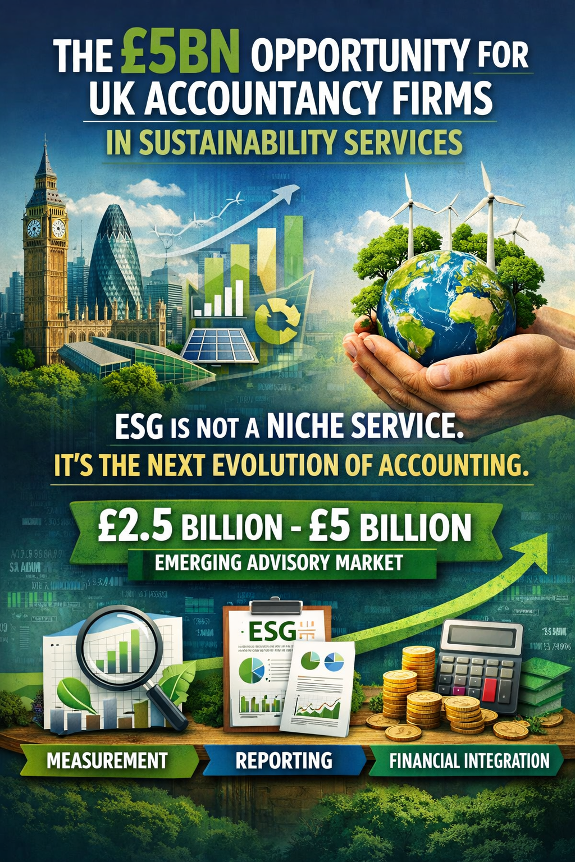
For UK Accountancy firms, ESG is not a niche service. It’s the next evolution of accounting. It is a £2.5 billion - £5 billion emerging advisory market built on measurement, reporting and financial integration.
Firms that move early will own the “non-financial reporting” layer of the SME economy.
Become embedded in client decision-making
Build new recurring revenue
Future-proof audit/advisory
Firms that don’t:
Get pushed down into low-margin compliance work
References:
1. Allica Bank. (2024, June 17). Rebooting SME finance to unlock growth. https://www.allica.bank/press-releases/allica-urges-government-to-supercharge-successful-growth-guarantee-lending-schemes-and-review-prudential-framework-as-new-research-reveals-up-to-6-1745785522366
2. British Business Bank. SME Intermediary Survey 2024. https://www.british-business-bank.co.uk/about/research-and-publications/small-business-finance-markets-report-2025/sme-intermediary-research-uk-findings
3. Sage Group. (2025, October). SME sustainable finance stocktake. https://www.sage.com/en-gb/company/digital-newsroom/2025/10/sage-report-shows-record-sme-sustainability-ambition/
4. International Chamber of Commerce. Path for Growth: Making sustainability reporting work for SMEs. https://iccwbo.org/news-publications/policies-reports/path-for-growth-making-sustainability-reporting-work-for-smes/
5. ICAEW (2026, February). Government publishes UK Sustainability Reporting Standards. https://www.icaew.com/insights/viewpoints-on-the-news/2026/feb-2026/government-publishes-uk-sustainability-reporting-standards
6. Department for Business and Trade. (2024, May 16). Sustainability disclosure requirements: Implementation update 2024. GOV.UK. https://www.gov.uk/government/publications/uk-sustainability-disclosure-standards
7. Accountancy Age (2025, January). Climate reporting demand catches 67% of accountants off guard https://accountancyage.com/2025/01/28/climate-reporting-demand-catches-67-of-accountants-off-guard/
8. Money.co.uk (2025, September). Sustainability in business: latest trends and statistics. https://www.money.co.uk/business/business-statistics/business-sustainability-report
9. Make UK (2024, February) ESG in Manufacturing. https://www.makeuk.org/insights/reports/2024/01/29/esg-in-manufacturing


Comments